ROBOne: AI-powered sorting robotics
Client: ROBOne (later acquired by Korea Zinc) Services: Interactive 3D product showcase + marketing website Duration: 12 weeks total (3D app + web build in parallel) Tech: Three.js + Verge3D (3D app); WordPress + Elementor (web); bilingual EN/KO
The problem
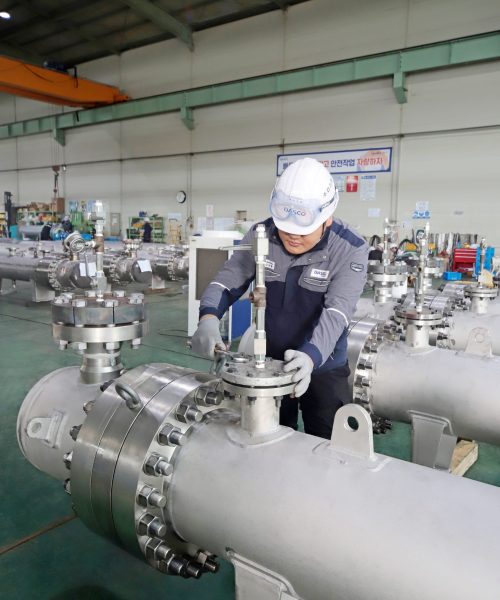
ROBOne makes AI-powered waste-sorting robotics. A category that didn't really exist a decade ago and now occupies a specific niche in industrial recycling, municipal waste management, and circular-economy infrastructure. The technology combines computer vision, robotic actuation, and material-specific sorting logic into a single production system.
Their challenge was twofold: marketing to industrial distributors and waste-management operators who needed to understand the hardware, and a larger narrative challenge of positioning the company credibly in the sustainability / AI-industrial convergence.
The request: a 3D interactive showcase of the sorting hardware for distributor sales, plus a corporate marketing site that made the AI-and-robotics story legible to both industrial buyers and broader stakeholders.
What we built
1. Interactive 3D product showcase
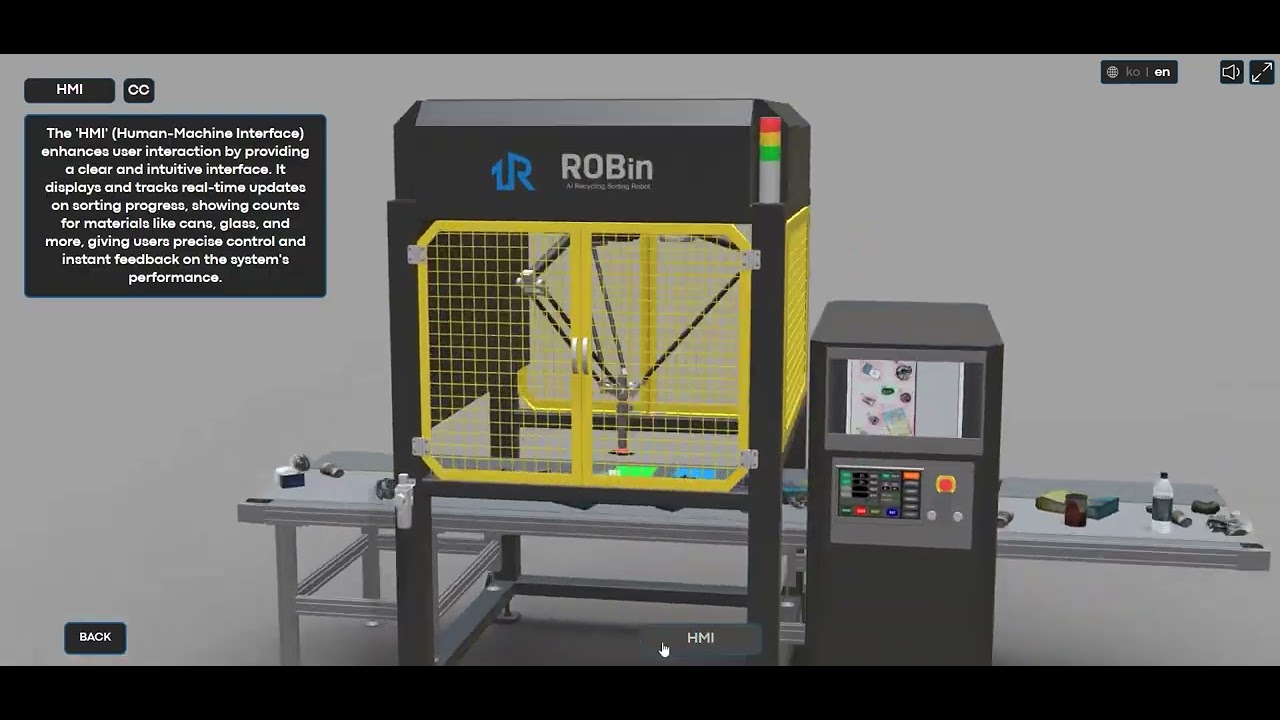
A browser-based 3D tour of the sorting robotics system. Sensors, robotic actuator, sorting belt, material-specific output bays. Visitors could orbit, zoom, and see the sorting cycle demonstrated as an animated sequence.
2. Marketing site
Bilingual Korean/English marketing site covering the company, technology, products, case studies, careers, and news. Built on WordPress with Elementor for in-house post-launch editing.
- 3D-vision product narrative. Threaded through the technology pages as well as the product pages
- Service/maintenance portal. Distributor-facing resource for post-sale support
- YouTube integration. Video content from product demonstrations and industry talks
- Bilingual delivery. Korean primary for local market, English for international distributor network
- ESG framing. Sustainability narrative threaded through the site without overclaiming
How we built it
Two tracks ran in parallel for twelve weeks. The 3D showcase and the marketing site shared the same brand language and the same bilingual content spine, but they were two distinct production pipelines.
Weeks 1-2. Discovery and parallel kickoff. Stakeholder interviews with ROBOne's engineering and sales leads. CAD handoff for the sorting hardware. Site architecture mapped against the EN and KO buyer evaluation paths at the same time, since translating after structure is decided always breaks something.
Weeks 3–5. 3D asset build and site scaffolding. 3D track: hardware retopology from CAD, sorting-cycle animation, sensor and actuator callouts. Web track: WordPress and Elementor scaffold, WPML configured, base templates for technology, products, careers, and news.
Weeks 6–8. Integration and bilingual content load. 3D track: orbit and zoom interactions, animated sorting sequence, performance pass on mid-tier laptops. Web track: Korean copy first, English second, technology pages threaded with stills from the 3D showcase. Service and maintenance portal scoped and built.
Weeks 9–10. Cross-track review. First end-to-end review with ROBOne. The 3D narrative and the technology page narrative were rewritten to match each other rather than overlap. ESG language was tightened to specific technical anchors instead of category claims.
Week 11. Performance and SEO. LCP tuning, asset optimization, structured data, hreflang for the EN and KO trees.
Week 12. Handover. Editorial training for ROBOne's in-house team on Elementor and WPML, distributor-portal walkthrough, launch.
What it changed
ROBOne's distributor sales team stopped sending PDF spec sheets ahead of qualification calls and started sending the 3D showcase link. The hardware story became something a prospect could explore on their own before the meeting, which shortened the first sales conversation and shifted it from "what does this thing do" to "where would it fit in our line."
The bilingual site became the primary inbound channel for international distributor inquiries, with the EN tree carrying the load that previously had no English-language home.
Korea Zinc later acquired ROBOne.
What we learned
Two tracks need one content spine, decided in week one. The 3D showcase and the marketing site are different production pipelines, but a prospect experiences them as one product story. We locked the bilingual content spine, the terminology list, and the EN/KO buyer evaluation path before either track started building. That single decision is the reason the 3D narrative and the technology pages did not need a rewrite at week ten. Parallel tracks save calendar time only if the upstream content work is sequential.
"AI" as marketing term ages poorly; "AI + specific technology" ages well. The ROBOne site says "AI-powered computer-vision sorting" with specific technical anchors. It doesn't say "AI-native," "AI-first," or any of the 2024-26 era claims that sound hollow twelve months later. Specificity beats language trends.
Service/maintenance portals are underrated. The distributor-facing service portal was a small feature on launch and became one of the site's most-used areas post-deployment. Industrial buyers think about service availability before they think about product features. Designing the site to surface that credibility turned out to be one of the highest-impact decisions we made.
Stack
3D showcase
- Runtime: Three.js + Verge3D
- Assets: GLTF with Draco compression
- UI: HTML/CSS overlays, bilingual text
Website
- Framework: WordPress with Elementor (client requirement for internal post-launch editing)
- Languages: Korean + English via WPML
- Hosting: client-managed Korean hosting
- Performance: LCP under 2.5s on 4G, full-page AMP-adjacent optimization
Want something similar?
If you're building a complex industrial or AI-industrial product that needs both a browser-based 3D showcase and a technically-credible marketing site, the ROBOne pattern is the most directly applicable case in our portfolio.
Send a two-sentence email to info@cclemang.com.