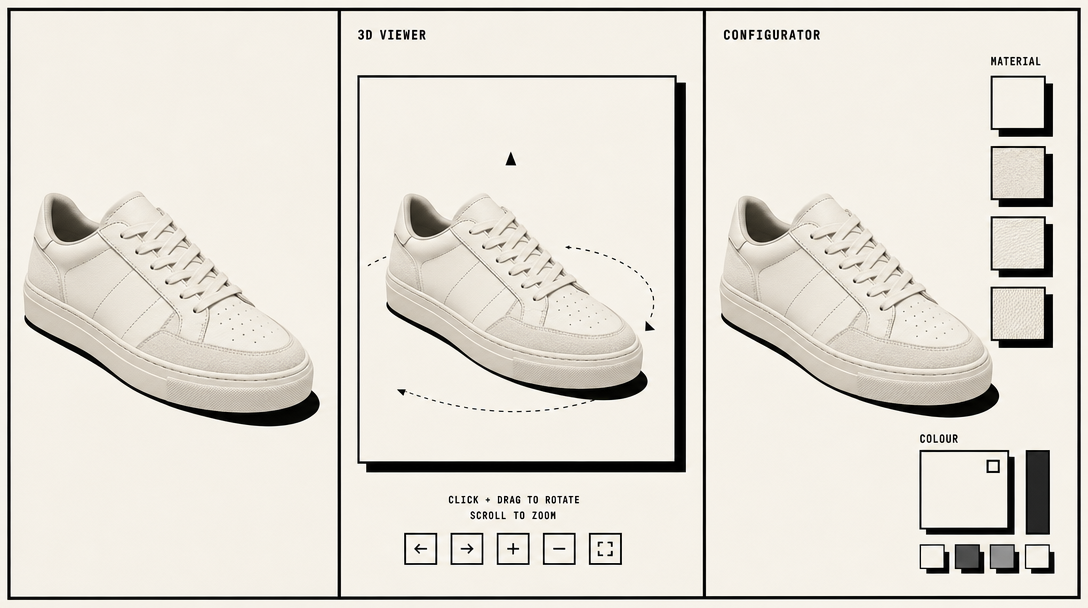
The three instruments, defined plainly
There are three tools in the toolkit. They do different jobs at different prices. Understanding what each one is actually for, and what it is not for, is the first step.
Better photography
Professionally styled product imagery. Multiple angles, on-figure or in-context shots, lifestyle frames, sometimes a short loop of motion. The classic e-commerce visual layer.
Photography communicates brand, finish, scale, and lifestyle context. It works in every channel without technical overhead. Email, paid ads, print, marketplace listings, the product page itself. One shoot funds a year of marketing assets.
What it cannot do: show internal construction, let the buyer explore at their own pace, or handle deep variant depth without exploding the asset count. A product page with fifteen photos can imply variety. It cannot let the buyer build a configuration.
3D viewer
A single-product 3D presentation. Rotate, zoom, sometimes hotspots or annotations or scripted camera moves. Camera control is the interaction. There is no commerce, no variant building, no order capture.
A viewer is the right tool when the product has form, scale, or internal structure that photography cannot reach. KBIC's facial roller is a good example. The product looks simple from the outside. Its value is in the internal needle array and the rotation mechanism. We built a cross-section view that showed the engineering, and conversion lifted on the product page because buyers could finally see what made the $60 device different from a $20 knockoff. Photography would never have closed that gap.
Zion Dental is a different shape of viewer. A dentist on a chairside iPad walks a nervous patient through an implant procedure. The buyer is making a yes-or-no decision about treatment, not a configuration choice. The viewer's job is to make the procedure legible enough that the patient says yes. That is a single-decision tool. Configurator-class complexity would be wrong.
Dowon APEX is the upper end of viewer territory. A full wastewater-treatment plant in the browser, with twenty pieces of equipment selectable in operational context. Distributors now open sales calls with the walkthrough instead of a slide deck. It replaced the first 40 minutes of pitch. No commerce, no variants, no ordering. Just context that lets a buyer understand a $200,000 piece of industrial equipment without flying to a reference site.
3D configurator
Real-time variant selection. Color, material, size, feature. The 3D scene updates live as the buyer builds the configuration they want. Usually integrated with order capture or commerce.
A configurator is the right tool when the buyer has to assemble a specific configuration before they can commit. Rawfit is the canonical version. Two flagship sneaker models, five colors each, three materials each. On a 2D catalogue the depth disappears. Customers see four photos and assume four options. With the configurator they can pick the exact pair they want, see the leather they chose, capture it, and submit an inquiry. Conversion on configured SKUs ran above unconfigured SKUs in the same category. That is a configurator earning its keep.
Configurators are software. They have ongoing maintenance. New materials, new variants, commerce integrations to keep in sync, browser-version regressions to patch. If the product does not justify that overhead, you have bought a maintenance liability.