Zion Dental: Patient education 3D
Client: Zion Ics Year: 2023 Services: Interactive 3D, Medical Education, Patient Communication Duration: 8 weeks Tech: Three.js, Verge3D
The problem
Zion Ics manufactures precision dental implants. Their buyer is twofold: the dental practice that purchases and installs the implants, and (indirectly) the patient who's deciding whether to proceed with a treatment.
Traditional patient-education content in dentistry is stock-video-tier: generic animations from medical-content libraries that dentists license by subscription. The content is fine, but it's the same content every dentist uses. Zion wanted their practices to have a branded, Zion-specific 3D explainer. Something distinctive on a dentist's tablet during a consultation, something that demonstrated the specific Zion implant procedure, and something that would help a nervous patient say yes to treatment.
What we built
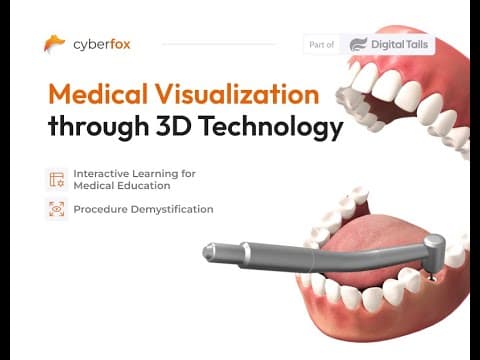
A browser-based 3D patient-education tool, designed for use on a dental-office tablet during consults.
- 3D cross-section of a jaw with implant placement. The user (dentist or patient) rotates and zooms around the model
- Step-by-step procedure. A guided sequence through the placement procedure, from initial assessment through osseointegration and final crown
- Post-op care module. What the patient does and doesn't do during recovery, surfaced as a separate module the dentist can show separately
- Annotation layer. Anatomical labels, device callouts, timeline indicators
- Zion brand integration. Subtle but consistent presence of Zion branding, differentiating from stock medical content
- Dentist-paced interaction. The dentist controls the session, pausing at questions; no auto-playing content
How we built it
Weeks 1–2. Kickoff, clinical accuracy review with Zion's dental advisors. We did not build medical content without clinical sign-off at every stage.
Weeks 3–4. 3D asset build. Jaw anatomy, implant hardware, surrounding tissue. Medical-accuracy review at end of week 4.
Weeks 5–6. Procedure sequencing and annotation layer. Dentist-facing UI design. First clinical review.
Week 7. Brand integration, post-op care module, performance tuning.
Week 8. Tablet deployment testing, dentist training materials, launch.
What it changed
Zion's partner dental practices now use the tool as the primary patient-education asset for implant consultations. Patient-consent conversion improved meaningfully over the prior stock-video content.
What we learned
Medical accuracy is not negotiable and not optional. Every clinical detail in the tool passed through clinical review before it shipped. The review cycle added two weeks to the project and was the single most-valuable two weeks of the build. Credibility with dentists (the people showing this tool to their patients) is built on exactly this kind of discipline.
Dentist-paced interaction beats auto-play. Early drafts had auto-advancing content with timed transitions. Dentists disabled the auto-play immediately. They wanted to pause at each step for patient questions. We flipped the interaction model to dentist-controlled advancement. Engagement went up; dentist adoption went up; patients stayed more engaged because the dentist could respond to them in real time.
Post-op care is a separate module for a reason. The first version combined procedure and post-op care into one continuous flow. Dentists didn't want that. They show procedure content before the appointment and post-op content at the end. We split into two modules, each independently launchable. Immediately more useful.
Stack
- Runtime: Three.js + Verge3D
- UI: Vanilla TypeScript (no framework overhead for a single-purpose tool), HTML/CSS overlays
- Assets: GLTF with Draco compression, ~6 MB for the full set
- Performance budget: 60 fps on a 2020 iPad, 30 fps on older Android tablets
- Deployment: Hosted on Zion's subdomain; offline-capable via Service Worker so dentists can show it in areas with poor office WiFi
Want something similar?
Patient education, medical-device marketing, clinical training. The pattern generalizes beyond dentistry. If you make a medical device or a procedure that patients or practitioners need to understand, the tool shape works.
Send a two-sentence email to hello@cclemang.com.